Ical Download Mac Os X 10.5.8
AppleInsider is supported by its audience and may earn commission every bit an Amazon Acquaintance and affiliate partner on qualifying purchases. These chapter partnerships practise not influence our editorial content.
Apple has made major changes to iCal in Mac OS X ten.5 Leopard, introducing integration with its own new WebDAV-based iCal Server included in Leopard Server. Here's a comprehensive history of software-based calendar applications and a await at what's new in iCal three.0.
iCal Origins
Beyond accessing a agenda to simply look up the date, the thought of calendaring and organizing event information dates back to 1973, with the release of PLATO Notes by the University of Illinois' Computer-based Instruction Research Laboratory. Originally designed as a way to runway issues reports at CERL, the system developed into a way to organize distributed collections of Notes, secured by permission access lists, organized by engagement, and eventually shared between other systems.
Developers of PLATO Notes, including Ray Ozzie, Tim Halvorsen, and Len Kawell, later left the university and connected development work at other companies. At Digital, developers from CERL produced a product called DECNotes. Ozzie went to piece of work for Lotus Development.
Desktop Organizer Software
The thought of scheduling and organizing events with desktop PC software dates dorsum to Lotus Agenda (below), a DOS program from 1987 that billed itself as a 'personal information manager' and was usually described as a "spreadsheet for ideas."
Lotus had earlier released the wildly pop 1-ii-3 spreadsheet. The company was founded by Mitch Kapor, an early PC software pioneer who had gotten started at VisiCorp, the maker of VisiCalc, which was both the start computer spreadsheet and the killer app that launched the market place for personal computers with the Apple II in 1979.
Lotus Agenda pioneered data organization in a novel way using a flexible database. Users assigned new data entry Items to multiple Categories of their own blueprint. They could and then relate together ideas using Filters to search, and present items in Views. This made the system powerful, only its complexity gave information technology a steep learning curve.
Lotus Notes
In 1984, Ozzie had left Lotus to start Iris, a project funded by Lotus to develop a organisation similar to PLATO Notes for utilize on personal computers. The task of migrating Notes' online give-and-take, email, contact and document directories to the PC was a bit much for PCs of the early on 80s; Notes had to devise a way to distribute much of the work to a dedicated server. Information technology also had to roll a lot of its ain operating organization functionality, since DOS didn't offering much sophistication underneath its applications.
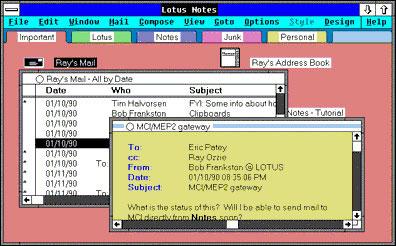
The system was released in 1989 every bit Lotus Notes 1.0 (below). Information technology ran on both DOS and IBM's Bone/ii. The new system launched the idea of client/server applications on PCs (as opposed to using a mainframe with attached dumb terminals) and kicked off the concept of groupware: networked collaboration, messaging, group scheduling, centralized contacts, and organized libraries of documents. Notes worked equally a arrangement of edifice blocks for creating integrated, custom corporate applications.
Graphical Calendaring
In 1990, PeopleCube introduced the MeetingMaker agenda for the Mac, which introduced graphical group scheduling. FirstClass (now endemic by Open up Text) arrived in the same period, delivering distributed messaging and online collaboration for the Mac that grew from origins as a graphical online bbs. In the mid 90s, FirstClass developed into a total groupware organization with scheduling features.
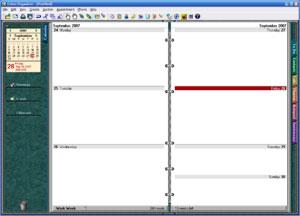
In 1992, Lotus released Organizer (above) for Windows, a graphical replacement for Agenda which presented events in handheld planner interface. Past the mid 90s, "Personal Information Manager" had become a popular buzzword. While Organizer maintained a clear pb on the PC, in that location were several competing calendar programs on the Mac:
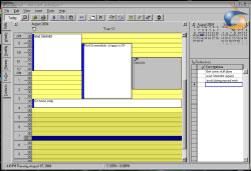
- Microsoft'south 1992 Schedule+ (above) was sold for the Mac and Windows.
- Now's Upward-To-Date and Contact.
- Datebook and TouchBase Pro, purchased by Aldus in 1993.
- Claris Organizer (below) appeared in 1995.
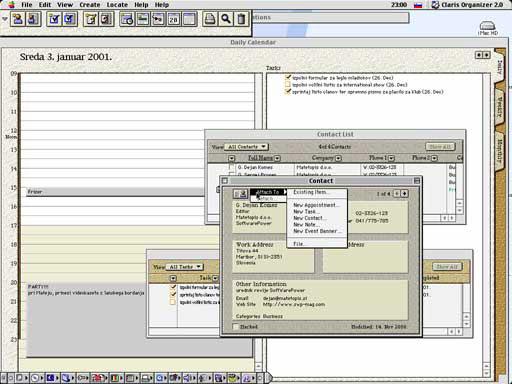
Claris Organizer incorporated Calendar, Contacts, Notes, and Tasks into a unmarried interface. Developers of the Palm Airplane pilot organizer were influenced past that design in creating their PDA, and the visitor later used Claris Organizer as its Palm desktop software on the Mac. Those same concepts would later evidence up Microsoft'due south Outlook, which debuted in 1997.
On page 2 of 3: Microsoft Advances into Desktop Calendaring; The Intersection of NeXT, Apple tree, Claris, and Microsoft; The Arrival of Jean-Marie Hullot's iCal; and Groupware Calendaring.
With the release of Windows 95, Microsoft leveraged its Windows PC software licensing agreements to button vendors to bundle licenses for Part 95 and Schedule+ with new PCs, a move that wiped the leading Lotus Organizer off desktops and into obscurity.
After IBM purchased Lotus Development in 1995, Microsoft was found to have "punished the IBM PC Company with higher prices, a belatedly license for Windows 95, and the withholding of technical and marketing support," according to the findings of fact in the United states vs Microsoft case looking into its PC monopoly.
As noted in Function Wars 4 - Microsoft’south Assault on Lotus and IBM, Microsoft had long been telling its DOS partners to port their applications to Bone/2, which helped ensure that its own Role suite would be the simply software available when Windows 95 shipped. Every bit a result, Microsoft rapidly transformed itself from a Mac developer into the leading vendor of PC applications within only a few years.
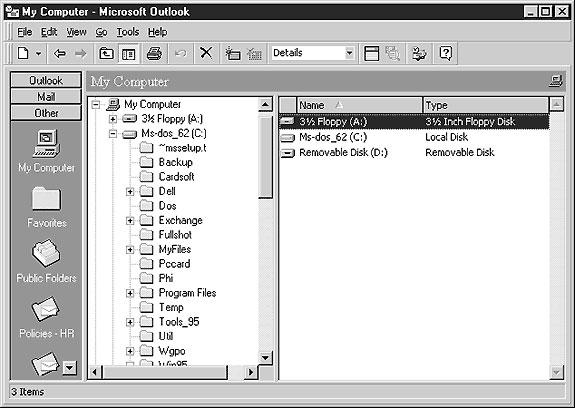
Microsoft halted development of Office on the Mac in 1994, and Apple's platform subsequently began to fall behind. By 1996, all of the momentum in the PC manufacture had shifted behind Windows and Microsoft, leaving the Mac with an aging portfolio of productivity applications. In 1997, Microsoft replaced its standalone Schedule+ calendar with a combined PIM application that merged email, calendaring, notes, tasks, and contacts into one application: Outlook. Different Claris Organizer, it also incorporated a file viewer (below).
The Intersection of NeXT, Apple, Claris, and Microsoft
In gild to pull Apple out of its death screw, ane of the start things Steve Jobs did after his return to Apple in 1997 was to kill everything that distracted from the goal of restoring the company'southward health. Amidst the casualties were the crumbling applications of its Claris subsidiary.
Claris Organizer was sold to Palm in 1998, which resold information technology as Palm Desktop 2.0 in order to improve Mac support for its Palm handheld organizers.
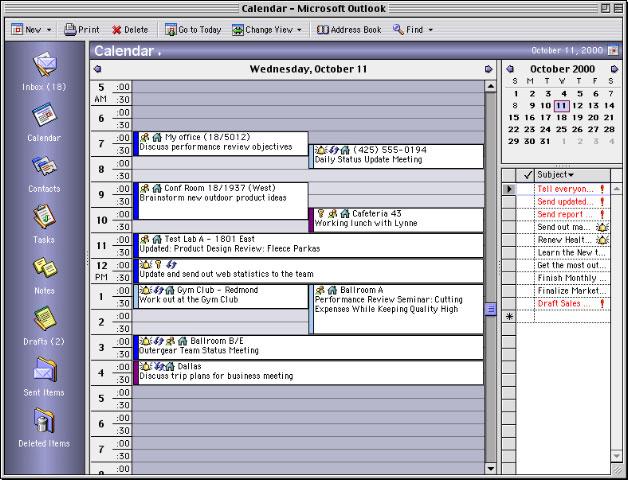
Apple too scuttled the popular Claris Emailer. Jud Spencer, its atomic number 82 programmer, went on to Microsoft's Mac Business concern Unit to work on Outlook Express and afterward Entourage, which took over equally the Mac version of Outlook afterwards Microsoft's Exchange group canceled Outlook for Mac (below) in 2001. The reason backside the move is explained in the posting Why did Microsoft supercede Outlook for Mac with Entourage?
Just prior to shutting down Claris, Jobs negotiated with Microsoft to evangelize a new Office for Mac, which was released in 1998. Information technology's non publicly known if Microsoft had whatever say in the dismantling of Apple tree's Claris applications or if those apps were only not worth maintaining past that point. However, it is interesting to notation that Jobs originally launched Microsoft into the awarding market place when he invited the company to develop for the Mac in 1982.
And so, after Microsoft packed upwardly its popular Mac applications and migrated them to the PC with Windows in 1991 (and abandoned the Mac in 1994), Jobs brought Microsoft back to the Mac and got it to deliver Office 98, Internet Explorer, Outlook Express, and later Entourage. During that menstruation from 1998 - 2002, Apple was struggling to evangelize its new operating system and rebuild the Mac platform, and would have been hard pressed to too deliver a suite of desktop applications on its own.
The Arrival of Jean-Marie Hullot's iCal
After Apple shipped Mac OS X 10.two Jaguar as the first mainstream release of its new operating system in 2002, it began piece of work on developing a series of its own desktop productivity applications. I of the first was iCal 1.0, which was offered as a gratuitous download for Jaguar users after that same twelvemonth.
The new iCal was unique in that it was not developed at Apple tree's Cupertino campus, but rather by a group of Apple employees in Paris. The French iCal evolution team was led by Jean-Marie Hullot, who years earlier had approached Apple with the idea of object-oriented interface development in the late 80s.
While the Mac's graphical interface was like shooting fish in a barrel to use, it was non easy to develop applications for information technology. Hullot devised a system called Interface Builder for creating a palette of interface elements which could exist graphically arranged, so fastened to functions. Apple's Jean Luis Gassédue east invited Hullot to travel to California, but he rapidly decided he didn't want to work for Apple. Instead, he shopped his thought effectually and ended up demonstrating Interface Builder at Side by side, where Jobs hired him immediately.
Interface Builder enabled rapid development on the NeXTSTEP platform, helping to fuel developments such every bit Tim Berners-Lee's World wide web. Hullot too worked on the Application Kit frameworks of NeXTSTEP. After Jobs returned to Apple years later, he invited Hullot to work on a scheduling awarding using a modern version of Interface Builder and the frameworks he had before developed to brand application design easy.
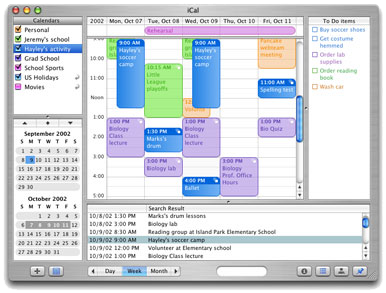
The release of iCal one.0 (beneath) demonstrated that complex applications with innovative user interfaces could exist developed rapidly on the new Mac OS X. It pioneered the concept of displaying the events of multiple calendars together in the same view. It made information technology piece of cake to publish agenda data to other users or subscribe to shared calendars on the Net. It also incorporated AppleScript support and could easily import information from other applications.
Apple supported the iCalendar format for sharing calendar information between systems, which had been developed by OpenText, IBM'southward Lotus, and Microsoft to promote interoperability in communicating free/busy fourth dimension, processing invitations, scheduling events, and handling to-practise lists.
Soon afterward, Apple released iSync for synchronizing calendar and contact data with mobile phones and Palm devices. By 2004, Palm had abandoned development of its Palm Desktop software, focusing instead on syncing with Outlook under Windows. Apple's move to deliver its own sync solution not only kept the Mac platform afloat in the wake of Palm's jumping ship, but also paved the way toward the evolution of the iPhone.
Groupware Calendaring
The arrival of iCal and iSync filled a void on the Mac platform for consumers, just iCal didn't provide whatsoever support for syncing group calendars with a central server. The market for groupware calendaring had largely been separate betwixt IBM's Domino server and its Lotus Notes customer on the high end of the enterprise market, and Microsoft'south Exchange Server and Outlook client on the low stop. Competing against Exchange were a number of calendar and groupware products like FirstClass and Meeting Maker— which Apple itself used for its corporate calendaring— along with a number of Exchange work-alikes, including:
- Stalker CommuniGate
- Kerio MailServer
- Open up-Xchange
For Leopard, Apple pulled its iCal development in house, and paired its iCal client with a new calendar server. Rather than trying to develop a monolithic groupware system that integrated calendaring into an email server and directory services, Apple built a standalone calendar server based on the open up CalDAV specification. It as well announced plans to release its agenda server every bit an open source project in the aforementioned blueprint as the Apache web server.
This strategy allowed Apple tree to focus specifically on the demands of a calendar server, rather than delivering a single production with a wide scope attempting to practice a picayune bit of everything. It also offers the open source customs an culling to emulating Exchange Server. By offer a standards compliant CalDAV server under the Apache license, Apple tin use the all-time existing email server while also sharing its calendar server to the community and Linux administrators, encouraging the adoption of CalDAV.
On page 3 of 3: Leopard's iCal 3.0; iCal Server; An Open Agenda; Lotus Notes, Symphony on Leopard; and I'd Like to Commutation This.
Even domicile users that accept no need for group calendaring will do good from the new server-side improvements to iCal. That's because Apple didn't only build its iCal Server to fill out a feature check list. It has also begun using information technology company broad as its ain corporate scheduling software in place of Meeting Maker. That means Apple employees are as well now using the iCal customer, and the result is that iCal itself has progressed rapidly.
Like other Leopard applications, the new iCal drops its heavy brushed metal interface and now make clean, lithe, and professional person looking (beneath). Information technology's also blazingly fast. Gone are the sluggish delays that left previous versions less than practical to actually use. It launches immediately, and new appointments can exist created and edited merely every bit quickly.
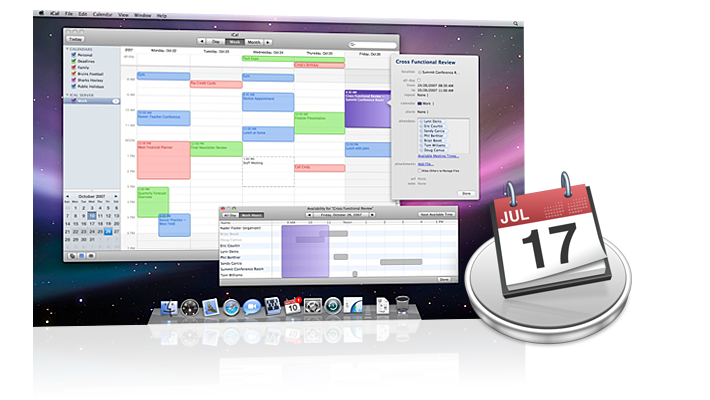
The new iCal drops the slide out drawer previous versions used to brandish and edit the details of events. In its identify, iCal 3.0 pops up an information chimera (above) when events are double clicked upon that can be used to view or edit the issue'south backdrop.
From the new Mail, users can create an upshot in iCal using Data Detectors. Doing so links the event dorsum to the electronic mail with a URL. Open the consequence in iCal, and a unmarried click pulls up the original email. Events also human activity similar email messages. Drag documents, graphics, or fifty-fifty movies to the result, and they are attached every bit files.
Invite participants to the effect, and your attachments are sent to the coming together recipients. To add attendees, simply click the attendees link and first typing names; iCal immediately looks up contacts from your Address Book for matches, and then offers to send out invitations. Users become a clickable file they tin can use to accept or decline your invitation, and iCal tracks their responses. It's like Commutation Server without maintaining expensive infrastructure and paying for all those Client Access Licenses.
iCal Server
In a group setting using Leopard Server, iCal gets fifty-fifty more than sophisticated. You can look up other users' availability (beneath), volume conference rooms, reserve the use of equipment such as an office projector, fifty-fifty delegate your calendar to an assistant to manage.
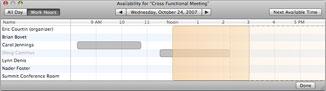
Because the new iCal Server is open, it works with a number of other clients on other platforms, too. A wide consortium of industry groups have joined to support and contribute toward CalDAV, including developers from Google, IBM's Lotus, Novell, Oracle, PeopleCube, Dominicus, Kerio, Mozilla, Yahoo, Zimbra, Symbian, and the OSAF.
Mozilla's Sunbird calendar and even Microsoft'due south Outlook— with the installation of a 3rd party plugin— can be used with iCal Server. Boeing has too adult a CalDAV connector for Exchange Server. Microsoft itself has been quiet about supporting CalDAV. That may be related to the fear that an open market in calendaring would not help the company maintain its dominance over Windows-spring It shops.
An Open Agenda
In an interesting turn of events, Kapor— the founder of Lotus who delivered the commencement personal data manager twenty years ago in Lotus Agenda and who funded the development of Lotus Notes— is once once more involved in the development of scheduling. Since 1990, Kapor has go known as a socially active philanthropist, co-founding the Electronic Frontier Foundation, founding the Open Source Applications Foundation, and chairing the Mozilla Foundation.
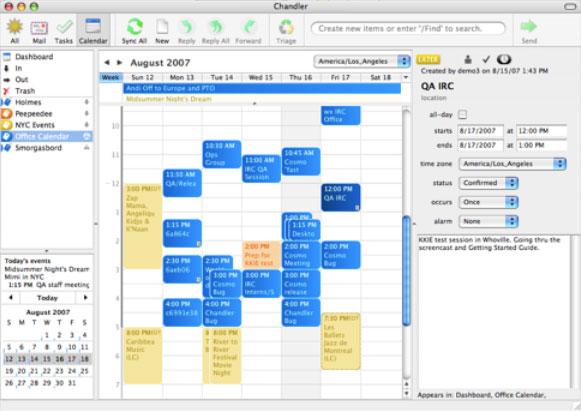
One of the projects of the OSAF is Chandler (below), a new PIM inspired by the old Lotus Agenda. The free, open source project is designed to help users to manage events, messages, and projects from a fundamental dashboard, schedule and coordinate meetings and events beyond multiple calendars, and collaborate with other users. Chandler is similarly based upon CalDAV, enabling its server and client to piece of work with Apple's iCal and iCal Server in Leopard.
Lotus Notes, Symphony on Leopard
IBM, meanwhile, is porting Lotus Notes 8 to the Mac for release early adjacent year. In the report Lotus Notes Domino 8 coming to Leopard in '08 last month, MacNN reported that IBM executives "described a 'new cachet' surrounding Macs in business, and said they 'see the growth' already underway on an enterprise level."
"Nosotros want to get it right," IBM said, "In fact, the version nosotros're currently running (Lotus Notes 8.x build on a Macbook on Flickr) on a widescreen iMac looks meliorate than the Windows release."
IBM is besides completing its own distribution of the OpenOffice productivity suite-with Notes integration— under the name Lotus Symphony. Released in beta with a full version due next year, IBM also promises a Mac version for its enterprise users. The suite is free and offered equally tool to compete against Microsoft's Exchange Server and Office integration.
I'd Like to Substitution This
Microsoft is also planning to release its next version of Part for Mac early next yr. The existing version of Office for Mac is now four years onetime— the same age every bit Office 4.x was back in 1997 when Jobs negotiated for the release of a new Office. Interestingly, Ozzie— the lead developer of the original Lotus Notes— is now the primary software architect at Microsoft, having replaced Bill Gates last year.
Mac users already take access to Apple tree's iWork 08 suite at present, and Leopard with the new iCal is but nine days away. Leopard Server and the new iCal Server are also coming out at the same time. At present that Apple tree has an interoperable production strategy for office scheduling, things are going to go interesting.
Ical Download Mac Os X 10.5.8
Posted by: bissonetteraiddece.blogspot.com